

For water and beach days, a UPF swim shirt is the more reliable barrier for covered skin. Sunscreen is still required for every exposed area, including the face, neck, and hands. Use both together for complete protection.
UPF fabric works continuously. It does not wash off, sweat off, or degrade between applications. Sunscreen, applied at real-world densities, often delivers less protection than the label suggests and needs reapplication after every swim or toweling session.
Quick verdict for your next water day:
- UPF 50+ swim shirts block about 98% of UV radiation on covered skin, with no reapplication needed
- Sunscreen is non-negotiable for the face, neck, ears, and hands
- Reapply sunscreen after every swim or toweling, within the 40- or 80-minute window on the label
- For children, BANZ® UPF 50+ swimwear is a reliable base layer that reduces missed-application risk on active days
Key Takeaways
| Point | Details |
|---|---|
| UPF fabric outperforms sunscreen on covered skin | Peer-reviewed testing found modern textiles provided superior UV protection compared to SPF 30 and SPF 50 sunscreens under study conditions. |
| Sunscreen water resistance has a time limit | FDA rules require labels to specify 40 or 80 minutes; reapply after every swim or toweling session within that window. |
| Real-world sunscreen application is often insufficient | Lab SPF ratings use 2 mg/cm²; most people apply less, reducing actual protection below the labeled SPF. |
| Combine both for complete coverage | UPF clothing covers the torso and arms reliably; sunscreen is still required for the face, neck, ears, and hands. |
| BANZ® for children | BANZ® UPF 50+ swimwear gives kids a consistent base layer that removes reapplication requirements for covered skin on active water days. |
This article is general information, not a substitute for advice from a qualified doctor. Consult a qualified healthcare professional about your own circumstances before acting on anything here.
Table of Contents
- What are swim shirts, rash guards, and UPF ratings?
- What does SPF mean, and how do FDA water-resistance rules work?
- How do swim shirts and sunscreen compare head to head?
- How does real-world use change protection during water activities?
- A step-by-step routine for combining a swim shirt and sunscreen
- How to choose a swim shirt and sunscreen that actually work
- What do dermatology and public-health authorities actually say?
- The case for fabric first, sunscreen second
- BANZ® UPF 50+ kids’ swimwear for water-day protection
- Sources
What are swim shirts, rash guards, and UPF ratings?
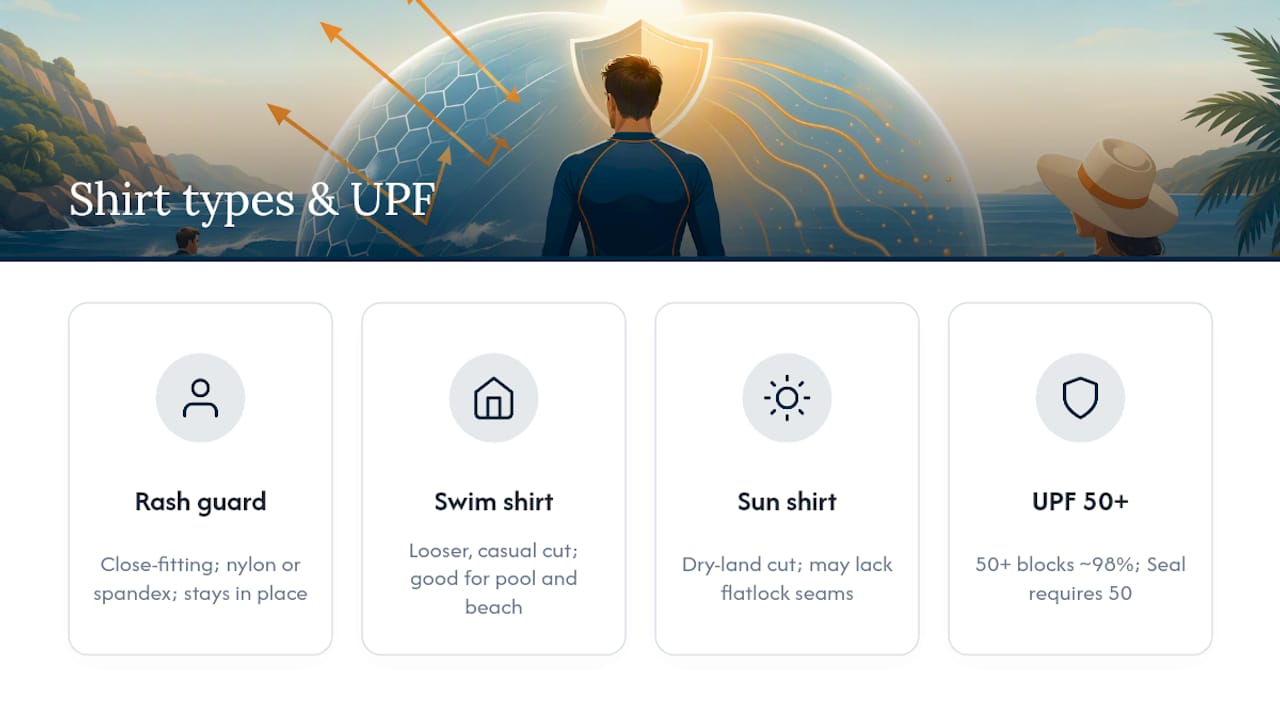
Swim shirts, rash guards, and sun shirts are related but not identical. A rash guard is a close-fitting, stretchy garment originally designed for surfing to prevent board rash. It is typically made from nylon or spandex, dries fast, and stays in place during active water use. A swim shirt is a looser, more casual cut that works for pool and beach days without the compression fit of a rash guard. A sun shirt is cut for dry-land use and may not have the flatlock seams or quick-dry fabric needed for swimming. When comparing a rashguard vs swim shirt for water activities, the rash guard’s snug fit and seam construction give it a slight edge in the water; a swim shirt suits casual beach use well.
UPF (Ultraviolet Protection Factor) measures how much UV radiation a fabric transmits. The Skin Cancer Foundation sets UPF 50 as the threshold for its Seal of Recommendation and classifies UPF 30–49 as very good protection. UPF is not the same as SPF. UPF measures fabric transmission of both UVA and UVB; SPF is derived from a time-to-reddening test and primarily reflects UVB protection. You cannot swap the numbers directly.
UPF 50+ blocks about 98% of UV radiation. The Skin Cancer Foundation Seal requires a minimum UPF 50 rating.
Pro Tip: Hold the garment up to bright light. If you can see your hand clearly through the fabric, the UV protection is likely low regardless of any label claim. Tight-weave, heavier synthetic fabrics offer the most reliable UPF. Loose knits and sheer fabrics often fall well below UPF 30.
When shopping, check the label for a stated UPF number. The Skin Cancer Foundation Seal is a useful third-party signal. Fabric composition matters: polyester and nylon with a tight weave consistently outperform cotton or loose-knit blends. For more on what the rating actually means in practice, the UPF 50 explained guide covers the numeric thresholds in plain terms.
What does SPF mean, and how do FDA water-resistance rules work?
SPF (Sun Protection Factor) measures how much longer it takes UV radiation to cause redness on sunscreen-protected skin compared to unprotected skin. The difference between SPF 30 and SPF 50 is smaller than most people expect, which is why dermatologists generally recommend SPF 30 as a practical minimum rather than insisting on the highest number available.
Broad-spectrum is a separate, required claim. It means the sunscreen protects against both UVA (aging, deeper skin damage) and UVB (burning). A sunscreen can have a high SPF and still offer minimal UVA protection if it is not labeled broad-spectrum. For skin cancer risk and photoaging, UVA protection matters as much as UVB.
The FDA’s sunscreen water-resistance rules require that any water-resistance claim on a label specify the tested retention time as either “water resistant (40 minutes)” or “water resistant (80 minutes).” No sunscreen is permitted to claim it is waterproof or sweat-proof. Reapplication directions on the label correspond directly to the tested duration.
How SPF is measured in the lab:
- A trained panel applies sunscreen at a density of 2 mg/cm² of skin surface.
- The skin is exposed to a UV source, and the time to redness is compared with unprotected skin.
- The resulting ratio is the SPF number.
The 2 mg/cm² density is roughly a full teaspoon for the face alone. Most people apply far less.
Common sunscreen mistakes that reduce real-world protection:
- Applying too little (the most frequent error)
- Missing the ears, back of the neck, tops of feet, and lip line
- Not reapplying after swimming, sweating, or toweling
- Using a product past its expiration date
- Relying on a single morning application for a full day outdoors
How do swim shirts and sunscreen compare head to head?
The swim shirt vs sunscreen decision comes down to six practical dimensions. Across most of them, UPF fabric holds a structural advantage for covered skin during water exposure. Sunscreen remains necessary for everything the fabric does not cover.
| Dimension | UPF swim shirt | Broad-spectrum sunscreen |
|---|---|---|
| Coverage area | Torso, arms, sometimes neck (garment-dependent) | Any exposed skin surface |
| Measured protection | UPF 50+ blocks about 98% UVA + UVB | SPF 30 filters about 97% UVB; UVA protection varies by formula |
| Water durability | Continuous; no reapplication needed for covered skin | Tested to 40 or 80 minutes per FDA label; must reapply after swimming or toweling |
| Real-world performance | Consistent; not affected by application density | Degrades with underapplication, sweating, and missed reapplication |
| Activity suitability | Excellent for swimming, surfing, paddle sports; rash guard fit best for active water use | Works for all activities but requires discipline to maintain coverage |
| Cost and lifespan | Higher upfront cost; lasts multiple seasons with proper care | Lower per-unit cost; needs regular repurchase and consistent use |
A peer-reviewed study published on PubMed measured four modern sun-protective textiles against two broad-spectrum sunscreens (SPF 30 and SPF 50) and found the textiles provided superior full-spectrum UV protection under the study’s measured conditions. Critically, the study tested sunscreens at both the recommended 2 mg/cm² density and a lower 1 mg/cm² density to simulate real-world underapplication. At the lower density, sunscreen performance dropped noticeably. Fabric performance did not change with user behavior.
Cleveland Clinic dermatology guidance frames UPF clothing as a reliable primary barrier for covered skin and sunscreen as the necessary complement for exposed areas. The key practical point: clothing protects continuously without any reapplication, which is a significant advantage during active water days when reapplication is frequently missed.
How does real-world use change protection during water activities?
Laboratory UPF ratings are measured on dry, unstretched fabric. Real conditions change things. A standard white T-shirt has a UPF of approximately 7 when dry. When wet, that same shirt can drop to a UPF of around 3, according to Skin Cancer Foundation data. Purpose-built UPF swim shirts and rash guards use tightly woven synthetic fabrics that retain most of their rated UPF when wet, but some degradation still occurs with stretching and prolonged submersion.
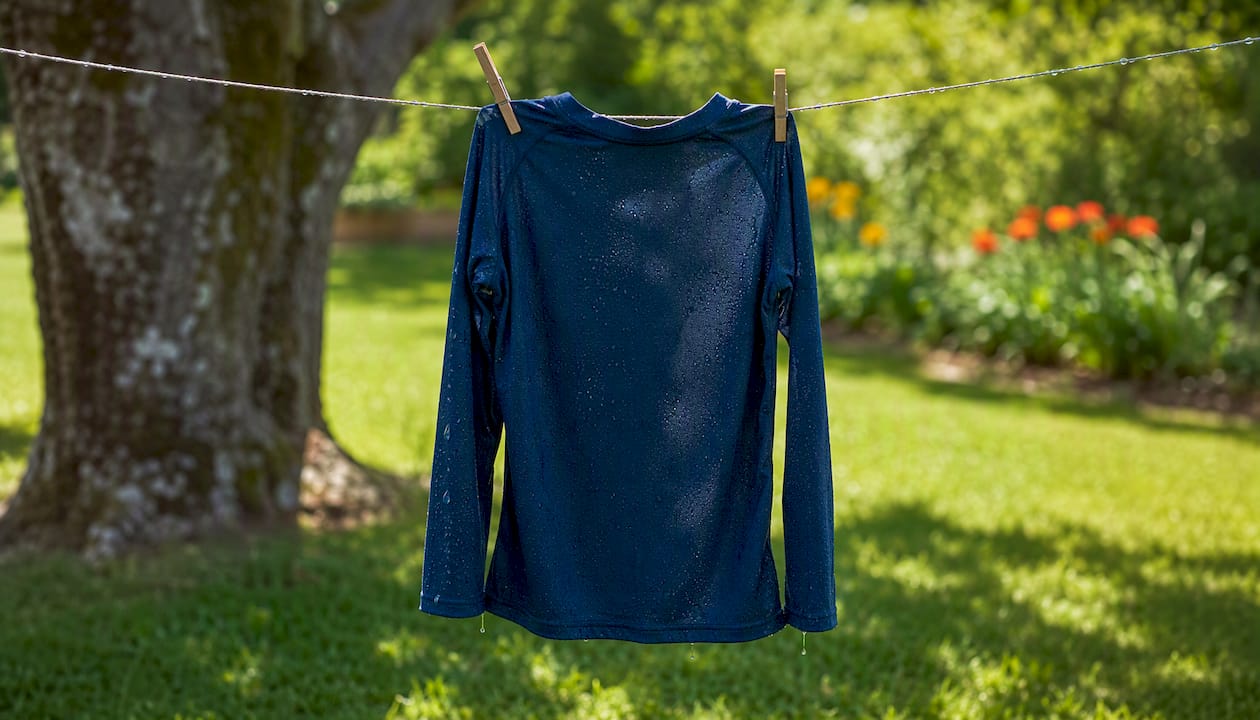
Toweling is a gap most people overlook. Every time a child or adult towels off, sunscreen is physically removed from the skin. The FDA’s water-resistance window (40 or 80 minutes) resets from the moment of reapplication, not from the start of the day. A family that applies sunscreen at 9 AM, swims from 10 AM to 11 AM, and towels off at 11 AM needs to reapply immediately, regardless of how much time has passed since the morning application.
Sand abrasion has a similar effect on sunscreen. Sitting on the beach, rolling in sand, or lying on a towel removes sunscreen from the back of the legs, shoulders, and upper back, which are areas that are easy to miss during reapplication.
Practical steps to maintain protection during active water days:
- Choose a UPF 50+ swim shirt or rash guard with a tight synthetic weave; avoid cotton or loose-knit options
- Reapply sunscreen immediately after toweling, not just after swimming
- Carry a spare dry UPF shirt; re-dress children promptly after toweling to close the exposure window
- Apply sunscreen to areas the garment shifts away from during movement (collar gaps, sleeve edges)
- At the beach, UV intensity is higher due to sand and water reflection; beach UV exposure warrants more frequent checks
Pro Tip: For surf lessons or multi-hour sessions in the water, a long-sleeve rash guard covers more skin than a short-sleeve option and removes the need to reapply sunscreen to the arms entirely. The long sleeve vs short sleeve rash guard choice is straightforward for extended water exposure: more coverage means fewer gaps.
A step-by-step routine for combining a swim shirt and sunscreen
Before you leave home:
- Check the UPF label on your swim shirt or rash guard. Confirm UPF 50+.
- Check sunscreen expiration dates. Discard anything past its date or stored in a hot car.
- Pack a spare dry UPF shirt for each child.
On arrival:
- Dress children in UPF garments before applying sunscreen. Clothing first reduces the skin surface that needs sunscreen.
- Apply broad-spectrum, water-resistant sunscreen (SPF 30 minimum) to all exposed skin: face, ears, neck, backs of hands, tops of feet, and any skin the garment does not cover. Use enough. For an adult’s full body, a shot-glass volume is the standard reference amount.
- Allow sunscreen to absorb for about 15 minutes before entering the water.
During the day:
- Reapply sunscreen after every swim or toweling session, within the water-resistance window on the label (40 or 80 minutes).
- Re-dress children in their UPF shirt after toweling rather than leaving them in just a swimsuit.
- Seek shade during peak UV hours (typically 10 AM to 4 PM).
Packing checklist for a beach or pool day:
- UPF 50+ swim shirt or rash guard (one per person, plus a spare for children)
- Broad-spectrum, water-resistant sunscreen, SPF 30+
- SPF lip balm
- UPF sun hat with a brim
- UV-protective sunglasses (children’s UV400 options from BANZ® cover the full eye area)
- Portable shade (umbrella or pop-up tent)
For children specifically: toddlers and young children rarely stay still for thorough sunscreen application. A UPF 50+ garment covering the torso and arms removes the need to apply and reapply sunscreen to those areas entirely. For parents navigating swim lessons or surf beach supervision, a UPF base layer is the most reliable way to maintain protection when reapplication windows are easy to miss. BANZ® kids’ UPF 50+ swimwear is designed for this exact use case. See the complete parent UV protection guide for age-specific guidance.
How to choose a swim shirt and sunscreen that actually work
Swim shirt checklist
- UPF rating: Look for UPF 50+ on the label. UPF 30–49 is rated “very good” by the Skin Cancer Foundation but UPF 50+ is the standard for maximum protection.
- Fabric: Tightly woven polyester or nylon. Avoid cotton, which loses UPF rapidly when wet.
- Fit: Rash guards (close-fit) stay in place during active swimming; swim shirts (relaxed fit) suit casual beach use. Both work; choose based on activity level.
- Seams: Flatlock seams reduce chafing during extended water use.
- Opacity: Hold the garment to light before buying. If it is sheer, the UPF claim is suspect.
- Label verification: The Skin Cancer Foundation Seal confirms independent UPF testing. Check for it when available.
- Color: Darker and more saturated colors generally block more UV. Fabric color and UV blocking explains the relationship in practical terms.
Sunscreen checklist
- Broad-spectrum: Required. No exceptions.
- SPF: SPF 30 is the practical minimum; SPF 50 for children and high-altitude or midday exposure.
- Water resistance: Choose “water resistant (80 minutes)” for swimming days. “Water resistant (40 minutes)” suits light activity.
- Active ingredients: Mineral sunscreens (zinc oxide, titanium dioxide) are generally recommended for young children and sensitive skin.
- Expiration date: Check it. Sunscreen stored in heat degrades faster than the printed date suggests.
Maintenance tips
- Wash UPF garments in cool water with mild detergent. Bleach and fabric softeners degrade UV-blocking fibers.
- Avoid wringing or machine-drying on high heat; air-dry flat when possible.
- Repeated washing gradually reduces UPF. Replace garments that show visible wear, pilling, or thinning.
- Store sunscreen below 77°F. A beach bag left in a hot car can degrade the active ingredients within hours.
What do dermatology and public-health authorities actually say?
The recommendation to combine UPF clothing and sunscreen is not a marketing position. It comes from multiple independent sources that have examined the evidence.
Skin Cancer Foundation: The Foundation’s sun-protective clothing guidance explains that UPF measures both UVA and UVB transmission through fabric, sets UPF 50 as the threshold for its Seal, and notes that a standard white T-shirt provides only about UPF 7 when dry. The Foundation recommends UPF clothing as a primary protective layer.
FDA sunscreen labeling rules: The Federal Register rule on OTC sunscreen labeling prohibits “waterproof” claims and requires water-resistance labels to specify 40 or 80 minutes. This rule exists because earlier labeling allowed consumers to believe sunscreen lasted indefinitely in water. The current framework ties reapplication directly to the tested duration.
Cleveland Clinic: Dermatology guidance from the Cleveland Clinic states that UPF clothing and sunscreen are complementary tools. Clothing reliably protects covered skin without reapplication; sunscreen is still needed for the face, neck, and hands.
Slip versus Slop peer-reviewed study: The study measured four modern textiles and two broad-spectrum sunscreens (SPF 30 and SPF 50) under controlled conditions. Results showed textiles provided superior full-spectrum UV protection compared with the two sunscreens tested. The study also modeled sunscreen at 1 mg/cm² (below the recommended 2 mg/cm²) to reflect real-world underapplication, and protection dropped further at that density.
| Source | Core finding | Practical takeaway |
|---|---|---|
| Skin Cancer Foundation | UPF 50 blocks ~98% UVA + UVB; white T-shirt UPF ≈ 7 (dry) | Choose labeled UPF 50+ garments, not ordinary clothing |
| FDA (Federal Register) | Water resistance tested at 40 or 80 minutes; no “waterproof” claims permitted | Reapply sunscreen within the labeled window after every swim |
| Cleveland Clinic | UPF clothing and sunscreen are complementary; clothing covers reliably, sunscreen fills gaps | Use both; do not substitute one for the other |
| Slip versus Slop (PubMed) | Textiles outperformed SPF 30 and SPF 50 sunscreens under study conditions, especially at lower application density | Fabric is the more consistent barrier; sunscreen performance depends heavily on how much is applied |
The Slip versus Slop study found that four modern sun-protective textiles provided superior full-spectrum UV protection compared with two broad-spectrum sunscreens (SPF 30 and SPF 50) under the study’s measured conditions, including tests at both recommended and lower application densities. The difference between textiles and sunscreens was greater at the lower application density, which better simulates common real-world sunscreen use.
For children, the case for prioritizing UPF garments is especially strong. Consistent sunscreen application on an active toddler is difficult to maintain. A UPF 50+ garment covering the torso and arms removes the reapplication requirement for those areas entirely. BANZ® UPF 50+ kids’ swimwear is built to this standard, giving parents a reliable base layer that does not depend on perfect application technique.
The case for fabric first, sunscreen second
The conventional advice on sun protection often treats sunscreen as the primary tool and clothing as optional. The evidence points the other way, at least for water days.
Sunscreen is a chemical or mineral barrier that depends entirely on the person applying it. The lab conditions that produce an SPF number (2 mg/cm², even coverage, no sweating, no swimming) rarely exist in practice. The Slip versus Slop study makes this concrete: even at the recommended application density, the tested textiles outperformed both sunscreens. At the lower density that reflects real-world use, the gap widened. Fabric does not care how carefully you applied it.
The FDA’s water-resistance framework reinforces this. A sunscreen labeled “water resistant (80 minutes)” is not a set-and-forget solution. It is a 80-minute window that resets every time you towel off. On a six-hour beach day with multiple swims, that means at least four or five reapplications to maintain coverage, each one needing to be thorough and timely. Most people miss at least one.
None of this means sunscreen is the wrong choice. It is the only practical option for the face, neck, ears, and hands, and it fills every gap the garment leaves. The point is that treating sunscreen as the primary layer and clothing as a backup inverts the actual reliability of the two tools. Fabric is the consistent barrier. Sunscreen is the necessary complement.
For parents, this framing is especially useful. Getting a full sunscreen application on a moving child is hard. Getting them into a UPF 50+ swim shirt is not. Start with the garment, fill the gaps with sunscreen, and reapply sunscreen on schedule. That sequence matches what the evidence supports.
BANZ® UPF 50+ kids’ swimwear for water-day protection
Parents who want a reliable UPF base layer for their children without the guesswork of reapplication on covered skin can find it at BANZ®. BANZ® offers UPF 50+ swimwear and sun hats designed specifically for children, built to the Skin Cancer Foundation’s UPF 50 threshold and tested for water use.
The free BANZ Protect app adds real-time UV monitoring so you know when conditions require extra protection, not just when the clock says so. BANZ® has served over 2 million families across six continents, with a product line that covers sun protection from head to toe for children at the beach, pool, or any outdoor activity.
Check the BANZ® kids’ sun safety resource library for curated UV safety guidance, product options, and tools to help you build a complete water-day protection routine for your family.
Sources
- Sun-protective clothing | Skin Cancer Foundation
- Federal Register, Volume 76 Issue 117 (Friday, June 17, 2011)
- Does sun-protective clothing actually work? | Cleveland Clinic
- Slip versus Slop: A Head-to-Head Comparison of UV-Protective Clothing to Sunscreen | PubMed
Recommended
- UV Protection Sleeves for Outdoor Sports: What to Buy – BANZ® Carewear USA
- UV Protection Swimsuit for Kids and Caregivers: UPF 50+ Guide – BANZ® Carewear USA
- Rash Guards Aren’t Just for Swimming — The Case for Beyond-the-Pool Su – BANZ® Carewear USA
- Sun Sleeves That Work: UPF 50+ Buying Guide for Families – BANZ® Carewear USA
