

A couple needs a blanket sized for two people, a family of three or four does best with a square large enough to fit them comfortably, and groups of five or more should look at even larger blankets. The real trade-off is space versus portability: bigger blankets fit more people and gear but weigh more and pack bulkier. BANZ’s own family-sized picnic blanket targets that middle ground for parents juggling kids, coolers, and strollers.
TL;DR:
- A 60×70 inch blanket is the most common tested size suitable for two to three people and their food, but may be undersized if considering gear or larger groups.
- Square blankets around 72×72 inches comfortably seat four people plus gear, with weight and bulk increasing for sizes over 80×80 inches.
- Measuring your picnic spot and gear beforehand helps ensure the blanket fits your actual needs and avoids buying oversized or undersized options.
- Fabric type impacts cleaning, weight, and packability; waterproof-backed blankets are bulkier but protect against moisture, while fleece and cotton are easier to wash.
- Folded dimensions and weight are crucial for portability; mid-size blankets that fold into a small pouch and weigh under 2.2 pounds are practical for most families.
Table of Contents
- What Is the Right Picnic Blanket Size?
- Picnic Blanket Sizing Chart: Dimensions and Who They Fit
- How Many People Actually Fit on Each Size?
- How to Measure Your Picnic Spot and Existing Blanket
- Materials, Waterproofing, and Cleaning: What Affects Size and Care
- How Portable Is Each Blanket Size? Folded Dimensions and Weight
- Picnic Blanket Buying Checklist for Families
- Why Portability Matters More Than Size for Most Families
- BANZ Picnic Blanket: Built for Real Family Outings
- Sources
What Is the Right Picnic Blanket Size?
There’s no single “standard” picnic blanket size, even though a lot of retail listings throw that word around. What most guides call standard is closer to a starting point: about 50×60 inches, sized for two adults sitting close with a small basket between them, according to one retail size analysis. That number shows up so often because it matches the footprint of a compact car trunk and a folding chair, not because any organization set it as an official spec.
Product testing tells a slightly different story. When Serious Eats tested picnic blankets across several brands, most landed closer to 60×70 inches, big enough for two to three people plus food. One outlier, the NEMO, measured a full 95×95 inches and comfortably seated five to six people. That gap between the “standard” 50×60 and the tested 60×70 average matters: if you’re shopping by listing alone, you might undersize your blanket by a foot or more in each direction.
The honest answer to “how big should a picnic blanket be” depends entirely on who’s sitting on it and what’s coming with them. A toddler wriggling around needs buffer space a seated adult doesn’t. A cooler bag eats up two square feet before anyone even sits down. Ideal picnic blanket dimensions aren’t one number. They’re a range that shifts with your group size, your gear, and how much elbow room your family actually wants.
Picnic Blanket Sizing Chart: Dimensions and Who They Fit
Here’s how common sizes translate into real-world groups, based on tested product dimensions and standard retail measurements.
| Dimensions (inches) | Approx. size in feet | Best for | Notes |
|---|---|---|---|
| 50 × 60 | ~4 × 5 ft | Two adults, minimal gear | Common “standard” retail size; tight with a basket |
| 60 × 70 | ~5 × 5.8 ft | Two to three adults with food | Most frequently tested size across major brands |
| 72–78 × 72–78 | ~6 × 6 ft | Family of three or four, plus a cooler or small toys | Square shape gives more usable center space |
| 80 × 80 or larger (up to ~95 × 95) | ~6 × 6 ft to ~7.5 × 7.5 ft | Groups of five or more, or families with lots of gear | Heaviest and bulkiest to carry; needs a large flat site |
A quick conversion note: 60×70 inches works out to roughly 5 feet by 5.8 feet, and European-made blankets often list dimensions in centimeters. A brand size guide from Voited converts a 137×203 cm “double” blanket to 54×80 inches, which lands right between the standard and mid-size categories above. If a listing only gives centimeters, divide by 2.54 to get inches, or just remember that 100 cm is roughly 39 inches.
One thing the chart can’t show: shape changes how usable a size feels. A rectangular 60×70 blanket seats people in a line more naturally, while a square 72×72 gives you a center zone for food that nobody has to lean over. If your family picnics with kids who like to sprawl, square beats rectangular at the same total area.
How Many People Actually Fit on Each Size?
Numbers on a chart don’t tell you what it feels like to actually sit down with your family and a cooler. Here’s the practical breakdown.
- A 50×60 blanket fits two adults sitting cross-legged with a small basket between them, but there’s no room for anyone to lie back or stretch out.
- A 60×70 blanket gives two people enough space to sit and lean back, or three people to sit upright with food in the middle, matching what most tested products deliver.
- A 72–78 inch square blanket comfortably seats a family of four, plus room for a cooler bag and a couple of toys, as long as the kids aren’t running full laps.
- An 80×80 or larger blanket handles five or six people, or a family of four with a lot of gear spread around, though it starts getting heavy to carry.
Picture two common scenarios. Two adults with a wicker basket and a bottle of wine fit comfortably on a 60×70 blanket, with maybe six inches of buffer around the basket itself. A family of four with a soft-sided cooler, a diaper bag, and two kids who want to color needs closer to 78×78, because gear alone can claim a third of a smaller blanket’s surface before anyone sits down.
The rule of thumb parents forget: seated adults need about two feet of width each just for their own space, and that’s before food touches the ground. Add a cooler and you’ve claimed another two feet by one foot minimum. A stroller parked at the edge doesn’t count toward the blanket’s footprint, but a picnic basket that sits on the blanket absolutely does.
Sometimes two blankets beat one large one. If your group splits naturally, adults eating while toddlers nap or play nearby, two mid-size blankets (say, two 60×70s) give you flexibility a single giant blanket doesn’t. You can angle them for shade, separate a messy toddler zone from the food zone, or let one group leave early without disturbing the other. A single oversized blanket makes sense when everyone’s staying together for the whole visit and you’d rather not manage multiple pieces of fabric in the wind.
How to Measure Your Picnic Spot and Existing Blanket
Buying blind is how most families end up with a blanket that’s either swallowed by a shady patch of grass or too small once the cooler shows up. A few minutes with a tape measure fixes that.
- Measure your usual picnic spot’s flat, usable area. Walk the space and note where slope, roots, or shade start cutting into it. A “10 by 10 foot” lawn spot might only offer 7 by 7 feet of actually flat, shaded ground.
- Lay out your gear first. Set the cooler, basket, and any toys where you’d normally put them, then measure the footprint they take up before the blanket even goes down.
- Measure an existing blanket unfolded. Lay it flat on a floor and measure both length and width at the widest points, since some blankets taper slightly at corners.
- Measure it folded, too. Note the folded dimensions and weight if you can, since that number tells you how much space it eats in a car trunk, stroller basket, or backpack.
- Use household objects as sight references. A standard cooler bag is roughly 12×16 inches; a folded stroller footprint is often 20×30 inches. Picture two of either sitting on the blanket you’re considering.
Pro Tip: Measure your blanket folded, not just unfolded, before you buy a carrying bag or clip it to a stroller. A blanket that unfolds to a perfect 72×72 inches is useless if its folded pouch is too fat to fit in the diaper bag pocket you planned to use.
If you’re shopping online and can’t physically check a blanket before buying, ask for both sets of numbers in the listing. A retailer that only lists unfolded dimensions is leaving out half the picture families actually need.
Materials, Waterproofing, and Cleaning: What Affects Size and Care
The fabric a blanket is made from decides two things at once: how it feels to sit on, and how much trouble it is to clean after a spill. That connection matters more than most buyers realize when they’re focused purely on square footage.
Fleece tops are soft, lightweight, and about as forgiving as fabric gets for a family blanket. They tend to compress down small when folded, which helps if you’re already tight on trunk space. Cotton canvas is heavier and sturdier, standing up to rougher ground and repeated folding without pilling, but it holds more weight when wet and takes longer to dry. Waterproof-backed blankets, usually a fleece or cotton top bonded to a plastic or PVC layer, block ground moisture but add real bulk once folded, since that backing doesn’t compress like fabric alone. Woven plastic or tarp-style rugs sit at the other extreme: nearly indestructible against wet grass and easy to wipe down, but stiffer to fold and less comfortable to actually sit on for long stretches.
Cleaning depends entirely on which of those four you own.
- Fleece: gentle, cold machine wash cycle, then air dry rather than tumble dry.
- Cotton canvas: cold or warm machine wash is usually fine, and a low-heat dryer setting is often safe.
- Waterproof-backed: hand wash or spot clean only, then air dry, since machine washing and heat both risk peeling the coating.
- Woven plastic: wipe down with a damp cloth or hose off, no washing machine needed at all.
A specific number worth remembering: according to washing and care guidance for picnic blankets, machine washing on a gentle, cold cycle is generally safe for fleece and cotton blankets, but waterproof-backed and insulated versions need hand washing and air drying specifically to protect the coating underneath. Skip that distinction and a tumble dryer can quietly ruin a waterproof layer in a single cycle, long before the fabric itself shows wear.
Heat is the enemy across every material here. High dryer heat shrinks cotton unevenly, can melt or crack waterproof coatings, and warps woven plastic backings so they no longer lie flat. If you’re ever unsure which category your blanket falls into, treat it like the waterproof-backed group: hand wash, air dry, and skip the dryer entirely. It costs you a little time and protects a coating you can’t easily replace.
Parents managing grass stains, sunscreen smears, and juice spills tend to prefer whichever blanket lets them skip the guessing game. That’s a big part of why a washable top paired with a waterproof underside, rather than an all-plastic rug, tends to win out for families who picnic often. You get the wipeable protection where it counts and a soft, machine-washable surface where your kids actually sit.
How Portable Is Each Blanket Size? Folded Dimensions and Weight
A blanket’s unfolded size tells you where it’ll go once it’s down. Its folded size tells you whether you’ll actually want to bring it in the first place.
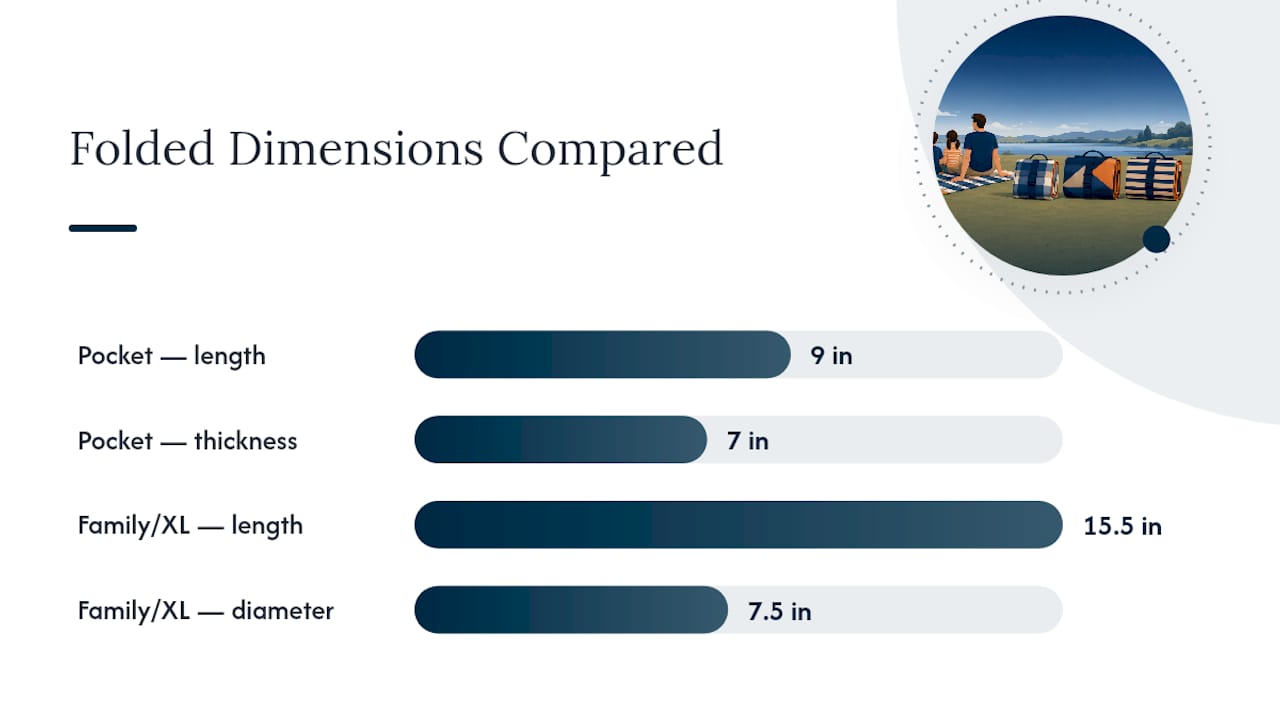
Product testing gives a useful range here. Compact “pocket” style blankets, the kind that fold into their own built-in pouch, can pack down to roughly 9 by 7 inches, barely bigger than a paperback book. Larger family and XL blankets fold to something closer to 15 to 16 inches long and 6 to 9 inches in diameter, based on tested folded dimensions across several brands. That’s roughly the size of a rolled yoga mat, manageable for a car trunk but a real consideration if you’re also carrying a diaper bag, a cooler, and possibly a toddler.
Weight matters just as much as folded size, maybe more for the parent doing the actual carrying. A family-sized blanket that stays under roughly 2.2 pounds strikes a practical balance: big enough for the group, light enough that one adult can manage it alongside a stroller and a snack bag without needing a second trip to the car. Waterproof-backed blankets tend to weigh more than plain fleece or canvas of the same size, since the backing adds material without adding usable surface area.
A few packing habits make the difference between a blanket that gets used weekly and one that sits in the garage:
- Use the built-in strap or pouch if the blanket comes with one, since loose folded fabric slips and unrolls in a trunk.
- Clip it to a stroller handlebar with a carabiner if you’re walking any real distance from the car to your spot.
- Roll rather than fold waterproof-backed blankets when possible, since tight folds along the same crease line eventually crack the coating.
- Choose the lighter option over the bigger one whenever you’re walking more than a few hundred feet, since an extra pound feels a lot heavier by the time you’re also holding a toddler’s hand.
If your family’s picnics usually mean a short walk from a nearby parking lot, size can win out over weight. If you’re hiking any real distance to a spot, or you know you’ll have a kid on your hip part of the way, a lighter mid-size blanket beats a heavier XL one almost every time, even if it means slightly less room once you arrive.
Picnic Blanket Buying Checklist for Families
Shopping for a blanket by photo alone is how families end up disappointed. Run through this list before you buy, whether you’re comparing listings side by side or standing in a store aisle.
- Confirm the unfolded size matches your typical group. Match it against the chart above rather than trusting a vague label like “family size” with no inches attached.
- Check for a waterproof backing. Damp grass ruins an afternoon fast, and a listing that doesn’t mention backing material at all is a red flag, not a neutral gap.
- Look for both folded dimensions and weight. A product page that lists only unfolded size is hiding half the information you need to judge portability.
- Verify the care instructions are fabric-specific. “Machine washable” without naming a cycle or water temperature isn’t enough detail to protect a waterproof coating.
- Look for pockets, straps, or stake loops. These small details decide whether the blanket stays put in wind and whether it’s easy to carry one-handed.
- Ask whether shade or UPF features are built in, if sun exposure is a regular concern for your family’s outings.
Pro Tip: A blanket description that skips folded dimensions entirely is usually hiding a bulkier pack size than the marketing photos suggest. If a listing won’t tell you, assume it packs bigger than it looks.
Watch for a few specific red flags while comparing options: no folded measurements listed anywhere, vague care language like “easy to clean” with no wash temperature specified, or a weight that seems unusually heavy for the stated size, often a sign of a dense backing layer that will feel like a chore to carry three trips into the season.
Why Portability Matters More Than Size for Most Families
Parents ask about picnic blanket dimensions expecting a simple answer, and the sizing chart above gives them one. What the chart can’t capture is how differently that same blanket behaves once a real family, not a showroom photo, is sitting on it with a diaper bag, a half-eaten sandwich, and a kid who wants to nap.
The conventional advice online treats bigger as automatically better. It isn’t. A 95×95 inch blanket that stays folded in a closet because it’s too bulky to grab on a Tuesday afternoon protects nobody. The blankets that actually get used week after week are the ones sized for a family’s real habits, not their theoretical maximum group size. Most families pack for their best-case outing (everyone comes, plus a cooler, plus a canopy) and then default to leaving the blanket home entirely on ordinary days because hauling it feels like too much.
BANZ’s origins in Australia came from exactly this kind of practical frustration: parents who couldn’t find gear built around how families actually move through a day outdoors, so they built it themselves. That same thinking applies here. A blanket sized right for typical use, and light enough that grabbing it doesn’t require a mental cost-benefit analysis, gets used far more often than the one theoretically “big enough” for every possible scenario.
If there’s one thing worth pushing back on, it’s the idea that folded dimensions are a minor spec. They’re often the actual deciding factor in whether a family picnics twice a month or twice a summer.
— Shari M. Murphy
BANZ Picnic Blanket: Built for Real Family Outings
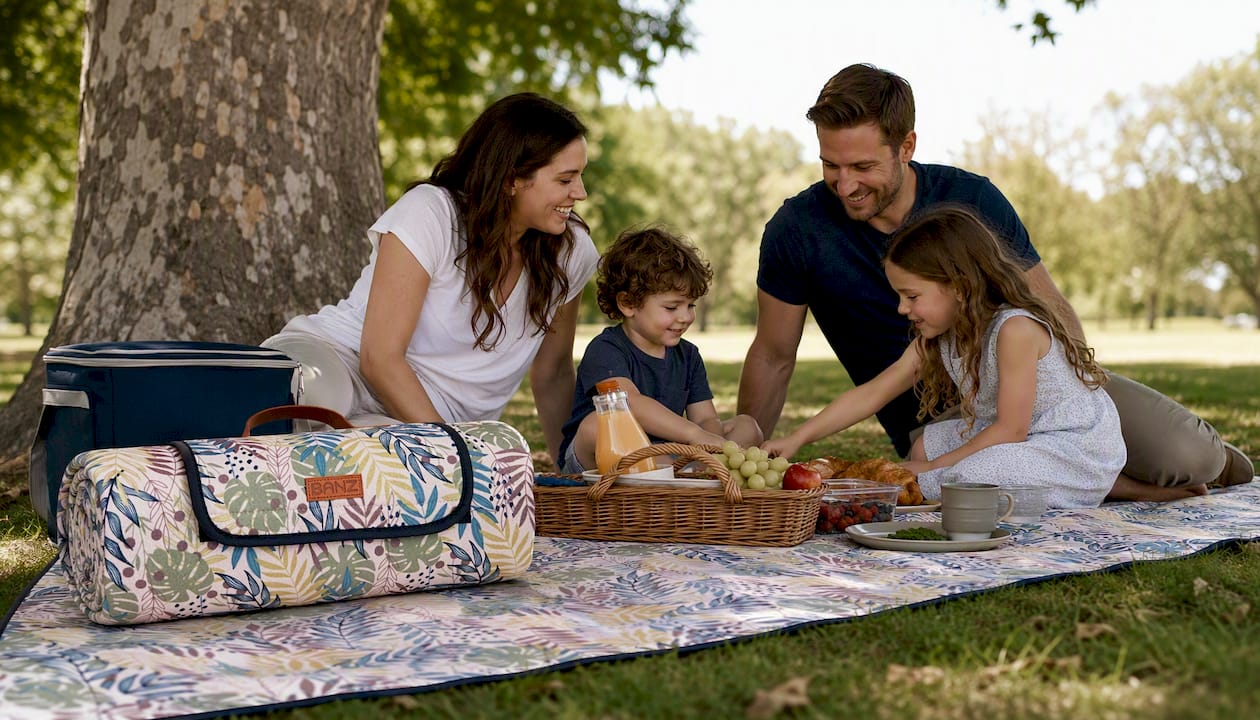
BANZ’s Picnic Waterproof Foldable Picnic Blanket is sized for the family sweet spot this guide keeps landing on: roomy enough for a family of four plus a cooler bag, without tipping into the bulky, hard-to-carry territory of oversized group blankets. It folds down to a compact, carry-friendly pouch and pairs a waterproof underside with an easy-clean top, so a damp lawn or a spilled juice box doesn’t turn into a laundry emergency.
Where BANZ pulls ahead of guessing your way through a generic retail listing is straightforward: you get a family-sized blanket built by a company that also makes UPF 50+ sun hats, sunglasses, and swimwear for the same outdoor afternoons, plus a free BANZ Protect app that tracks real-time UV exposure while your family is out on that blanket. That’s a rare pairing for a picnic accessory brand. Browse the full picnic gear collection if you also need a matching cooler bag, or head straight to the picnic blanket product page to check current sizing and add one to your cart before your next family outing.
Sources
The dimensions and care guidance throughout this article draw from hands-on product testing and dedicated care guides rather than marketing copy alone. Serious Eats’ tested picnic blanket roundup supplied the unfolded and folded measurements referenced in the sizing chart and portability sections. Washing and fabric-care recommendations came from a dedicated cleaning guide covering fleece, cotton, and waterproof-backed materials. Standard retail sizing figures referenced in the opening chart came from a size comparison breakdown, and metric conversion figures came from a brand size guide listing both inches and centimeters.
- The 7 Best Picnic Blankets of 2026, Tested & Reviewed
- How to Clean a Picnic Blanket: Washing, Stain Removal, and Storage
- The Best Picnic Blanket Size: 5 Stats You Need to Know