

Field trips raise a child’s UV risk because they place kids outdoors for extended, often uninterrupted periods during peak UV hours (roughly 10 a.m.–4 p.m.), producing the kind of intermittent intense exposures most strongly linked to melanoma. Before the next trip, pack these right now:
- UPF 50+ clothing layer and a broad-brim hat
- Wrap-around UV-blocking sunglasses
- Broad-spectrum water-resistant sunscreen with sufficient SPF, applied before school
- A small labeled sunscreen bottle for the teacher to support reapplication every ~2 hours
- A reusable water bottle
- Check the UV Index that morning (UV 3+ means full precautions; UV 6+ means plan for shade)
- Send a note to the teacher if your child needs help with sunscreen application
Table of Contents
- Why field trips increase UV risk: the science behind it
- When is UV high? How to check before the trip
- Sun-safety packing checklist for field trips
- How to choose sun-protection gear that actually works
- How risk changes with duration, surface, and activity
- Working with schools: what to ask and what to send
- What public-health authorities say about long-term risk
- How BANZ products and the BANZ Protect app support field-trip safety
- Key Takeaways
- A practical perspective on field-trip sun safety
- Ready-made options: BANZ gear and the BANZ Protect app
- Sources and further reading
Why field trips increase UV risk: the science behind it
The core issue is exposure pattern, not just total time outside. Intermittent intense exposures and childhood sunburns are linked more strongly to melanoma risk than chronic low-level exposure. A field trip compresses hours of direct sun into a single day, often without the reapplication reminders built into a normal school routine.
Reflective surfaces compound this. Snow can reflect up to 80% of UV; water and sand also bounce significant UV from multiple directions, effectively increasing the dose reaching a child’s face and eyes. A water park, a beach trip, or even a concrete plaza raises exposure well above what a shaded schoolyard produces.
Key stat: Roughly 60% of a day’s UV radiation arrives during peak midday hours. A full-day field trip that runs 9 a.m.–3 p.m. catches nearly all of it.
Critically, DNA damage relevant to skin cancer can occur well before visible redness appears. No burn does not mean no damage. UV also suppresses immune function and contributes to cataracts and other eye conditions, making sunglasses as important as sunscreen.
When is UV high? How to check before the trip
Check the UV Index first thing that morning. UV 3 or above calls for full sun protection; UV 6 or above means you should also ask the school about shade availability and whether outdoor time can shift to earlier in the day.
Three quick ways to check:
- Smartphone weather apps (Apple Weather, Google Weather) display the UV Index daily
- EPA EnviroFlash sends UV alerts by email for your zip code
- BANZ Protect app (free) gives real-time UV and noise monitoring with alerts you can set before a trip
Non-app clues matter too. Mid-morning to mid-afternoon, short shadows, and reflective surfaces (water, sand, light-colored pavement) all signal high UV regardless of temperature. A cool, partly cloudy day can still carry a UV Index of 6 or higher.
Pro Tip: Email the teacher the week before and ask two questions: What time will the group be outdoors? Is there shade at the venue? Those answers tell you exactly how much protection to pack.
Sun-safety packing checklist for field trips
Send this list with every outdoor school trip. The sun protection checklist for caregivers covers the full range; here is the field-trip version:
- UPF 50+ clothing layer (long-sleeve shirt or rash guard for water activities)
- Broad-brim hat (3-inch brim minimum, chin strap for active kids)
- Wrap-around UV-blocking sunglasses (UV400 or 100% UVA/UVB)
- Broad-spectrum SPF 30–50+ water-resistant sunscreen applied 15–30 minutes before leaving home
- Lip balm with SPF
- Small labeled sunscreen bottle for the teacher, with a sticky note: “Reapply at [time] and after water”
- Reusable water bottle (hydration supports the body’s response to heat and sun stress)
- Folding UV umbrella or compact shade panel for venues with no fixed shade
- Spare dry clothes for water or high-sweat activities
- Resealable bag for wet or used items
Reapply sunscreen every ~2 hours and immediately after swimming or heavy sweating. Apply enough to cover all exposed skin, roughly a teaspoon for the face and neck alone.
How to choose sun-protection gear that actually works
Not all gear is equal. Here is what the labels mean and what to prioritize.
UPF clothing
UPF 50+ blocks at least 98% of UV. Tighter weaves and darker or brighter colors generally block more UV than loose, pale fabrics. Check that the rating holds after washing; quality UPF garments state wash durability on the label. For a full breakdown, the UPF 50+ guide for parents covers certification and fit details.
Hats
A brim of at least 3 inches protects the face, ears, and back of the neck. Legionnaire-style hats (with a rear flap) add neck coverage for all-day outdoor events. Chin straps keep hats on active kids. Budget hats start around $10–$15; quality UPF-rated options with chin straps run $20–$35.
Sunglasses
Look for UV400 or “100% UVA/UVB protection” on the label. Wrap-around frames matter because reflected UV reaches the eyes from the sides, not just from above. Children’s UV-rated sunglasses typically range from $15 to $40 for reliable protection.
Stat callout: Shade reduced personal UV exposure by 55% in a schoolyard study of children during physical activity. Sunglasses and hats replicate that effect when fixed shade is unavailable.
Sunscreen
Broad-spectrum, SPF 30–50+, water-resistant. Mineral formulas (zinc oxide, titanium dioxide) sit on the skin surface and are generally well-tolerated by children with sensitive skin. Chemical formulas absorb faster and may suit older kids better. A family-size bottle runs $10–$20; travel-size refills for the teacher bag cost $5–$8.
How risk changes with duration, surface, and activity
| Scenario | Relative UV risk | Key action |
|---|---|---|
| 2-hour morning trip (before 10 a.m.) | Low | Sunscreen + hat sufficient |
| Half-day trip (10 a.m.–1 p.m.) | Moderate–High | Full kit; one reapplication |
| Full-day trip (9 a.m.–3 p.m.) | High | Full kit; two reapplications; shade plan |
| Water park or beach (any duration) | Very High | Water-resistant sunscreen; reapply after every swim; wrap sunglasses |
| Concrete plaza or urban venue | Moderate–High | Reflected UV from pavement; hat and sunglasses critical |
| Repeated field trips across a school year | Cumulative | Each trip adds to lifetime UV dose; consistent gear every time |
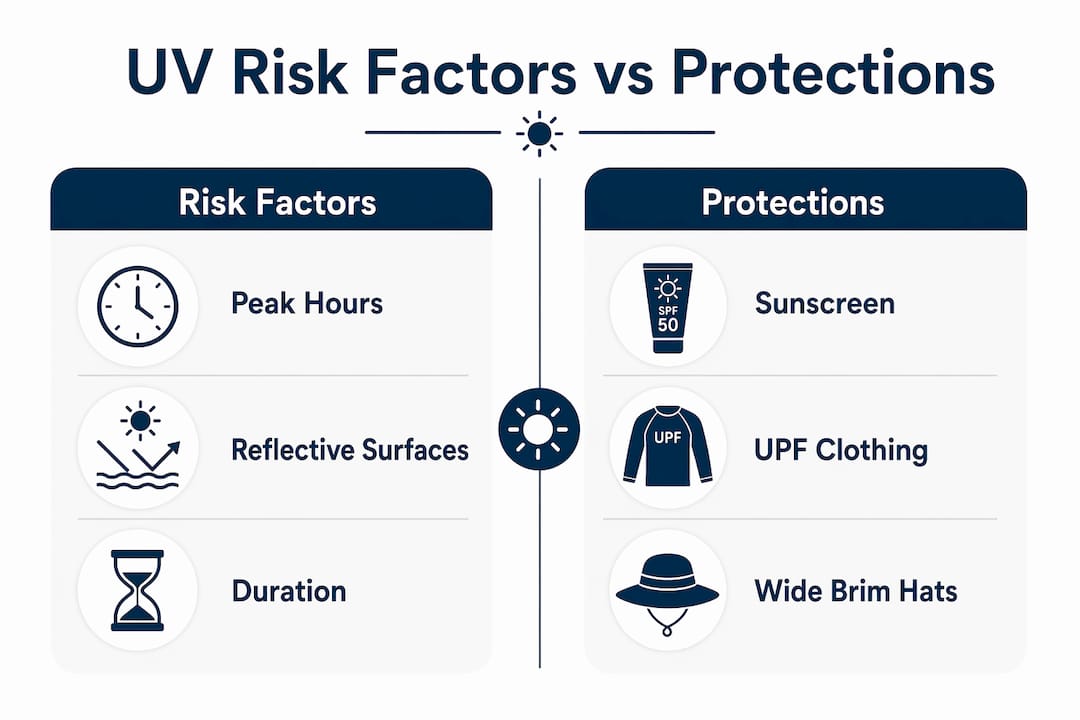
Across a full school year, even moderate individual exposures add up. Childhood UV exposure is a major risk factor for melanoma in later life, and the pattern of repeated outdoor events without protection is exactly how cumulative dose builds.
Working with schools: what to ask and what to send
EPA SunWise school templates recommend that sun safety be built into field-trip planning and permission slips. Most schools do not do this automatically. You can close that gap.
Ask on the permission slip or in a separate note:
- What time will students be outdoors, and for how long?
- Is there shade at the venue (trees, covered areas, or portable structures)?
- What is the school’s policy on sunscreen application by staff?
- Will students have access to drinking water throughout the day?
- Can outdoor timing shift earlier if the UV Index is high?
Practical steps:
- Label all gear with your child’s name
- Include a small sunscreen bottle with written reapplication instructions
- Offer to chaperone if the school needs extra hands for sun-safety tasks
- Request a schedule adjustment in writing if the UV Index forecast is 8 or above
Sample email to the teacher:
What public-health authorities say about long-term risk
The consensus across EPA, WHO, and CDC is clear: childhood intense UV exposures and sunburns significantly raise lifetime melanoma risk and contribute to eye damage and immune suppression.
The WHO confirms that children and adolescents are particularly vulnerable because of their skin and eye structure, and that sunburns in childhood directly increase the risk of skin cancer later in life. UV also reaches and damages the retina more easily in younger eyes.
The EPA links peak-hour outdoor exposure to cumulative lifetime UV dose, which drives skin cancer, cataracts, and immune effects. The CDC reinforces that intermittent intense exposures trigger inflammatory responses that raise future melanoma risk, separate from the effect of total lifetime dose.
Bottom line from the research: No visible burn does not mean no damage. UV damage is molecular and cumulative. Every unprotected field trip adds to a child’s lifetime total.
How BANZ products and the BANZ Protect app support field-trip safety
BANZ offers UPF 50+ sunglasses, broad-brim sun hats, and swimwear built to the checklist above, plus the free BANZ Protect app for real-time UV monitoring. Together they give parents a practical, packable system.
The BANZ Protect app lets you check the UV Index before the trip, set reapplication reminders, and monitor UV levels in real time. That matters on field trips because the normal school reapplication routine is absent. The app fills that gap without relying on a teacher to track the clock.
BANZ sunglasses carry UV400 protection with wrap-around coverage, addressing the reflected UV risk from water, sand, and pavement. BANZ hats include chin straps and broad brims suited to active kids who won’t keep a hat on otherwise. The gear is designed to work independently of adult supervision, which is exactly what field trips require.
“Parents should treat sun protection as part of daily attire for outdoor activities. Pack protection the way you’d pack shoes or a raincoat.”
BANZ draws on experience with over 2 million families across six continents. Why parents trust BANZ covers the full product and safety story.
Key Takeaways
Field trips raise UV risk because they concentrate prolonged outdoor exposure during peak hours, producing intermittent intense doses that drive melanoma risk more than chronic low-level exposure does.
| Point | Details |
|---|---|
| Peak hours are the core problem | Roughly 60% of daily UV arrives mid-day; field trips often run straight through it. |
| Intermittent burns drive melanoma risk | Short intense exposures and childhood sunburns are more strongly linked to melanoma than steady low-level exposure. |
| No burn does not mean no damage | DNA damage occurs before visible redness; a multi-layer approach (UPF clothing, hat, sunglasses, sunscreen) is needed every trip. |
| Reapply every ~2 hours | Send a labeled sunscreen bottle with the child and written instructions for the teacher. |
| BANZ gear and app | BANZ UPF 50+ sunglasses, hats, and the free BANZ Protect app map directly to the field-trip checklist. |
A practical perspective on field-trip sun safety
The gap between what parents know and what actually gets packed is usually not knowledge. It’s friction. A hat left by the door, sunscreen applied once and forgotten, sunglasses that slip off and get stuffed in a bag. The good news: you don’t need a perfect kit to make a real difference. One well-fitted hat, one application of SPF 30+ before school, and a note to the teacher about reapplication cuts the risk substantially. Start there. Add wrap-around sunglasses next. The outdoor sun safety gear guide has specific product examples when you’re ready to upgrade. Small, consistent steps across a school year matter more than a perfect single-trip kit.
Ready-made options: BANZ gear and the BANZ Protect app
BANZ makes it straightforward to cover the checklist without researching every item separately. UPF 50+ sunglasses, broad-brim hats with chin straps, and UV-protective swimwear are all available in one place, sized and tested for active kids.
The free BANZ Protect app adds real-time UV monitoring and reapplication reminders, so the protection plan runs even when no adult is watching the clock. For families heading to water parks, beaches, or full-day outdoor events, pairing the gear with the app covers both the physical and the timing gaps that field trips create.
Visit the BANZ kids’ sun safety resource library to browse products, download the app, and access EPA, CDC, and WHO sun-safety guides in one place. If you’re also packing for a beach or water day, the beach essentials checklist from Beach Bum Bags covers bag organization and packing tips that complement the sun-safety gear above.
Sources and further reading
- EPA: Health effects of UV radiation
- EPA SunWise school policy templates
- WHO: Ultraviolet radiation fact sheet
- WHO: Known health effects of UV radiation
- CDC: UV radiation and health
- Generation SunSmart / Cancer Council: UV risk reduction for schools
- Schoolyard shade and personal UV exposure study
- Photochemical & Photobiological Sciences: effects of solar radiation on health
- BANZ kids’ sun safety resource library
- BANZ UV safety resources and UV Index guide