

School sun protection policy best practices are evidence-based strategies schools must adopt to minimize students’ UV exposure and prevent long-term skin damage during outdoor activities. A complete sun safety policy covers scheduling, protective clothing, sunscreen protocols, shade provision, and student education. Each element works together. No single measure is enough on its own. This article breaks down the most effective sun safety guidelines for schools, giving administrators and educators a clear, practical framework to implement or update their outdoor activity policies right now.
1. What are the essential school sun protection policy best practices?
Effective UV protection practices for students start with a clear trigger point. Best-practice policies require sun protection whenever the UV index reaches 3 or above. That threshold matters because UV damage accumulates quickly, even when temperatures feel mild.
The core measures every school policy should include:
- Schedule outdoor activities outside peak UV hours. The highest-risk window is 10am–3pm. Physical education, recess, and outdoor events should be moved earlier in the morning or later in the afternoon wherever possible.
- Mandate sun-safe hats. Legionnaire, broad-brimmed, and bucket hats are required. Baseball caps leave ears and necks exposed and do not meet the standard.
- Require sun-protective clothing. UPF-rated fabrics, long sleeves, and collared shirts reduce direct skin exposure significantly. Policies should specify minimum coverage, not just recommend it.
- Enforce SPF 50+ sunscreen use. Schools should mandate SPF 50+ broad-spectrum, water-resistant sunscreen with reapplication every 2 hours. Water-resistant formulas last 40–80 minutes in active conditions, so reapplication is not optional.
- Provide adequate shade. Shade structures, trees, and covered areas must be available at play zones, sports fields, and eating areas.
- Use real-time UV monitoring. UV index trackers and apps support daily decision-making. The BANZ Protect app, for example, provides real-time UV readings that help staff decide when to bring students indoors or require additional protection.
Pro Tip: Post the daily UV index on a visible board near the school entrance each morning. Staff and students both adjust behavior faster when the number is visible.
2. How can schools integrate sun safety into daily routines?
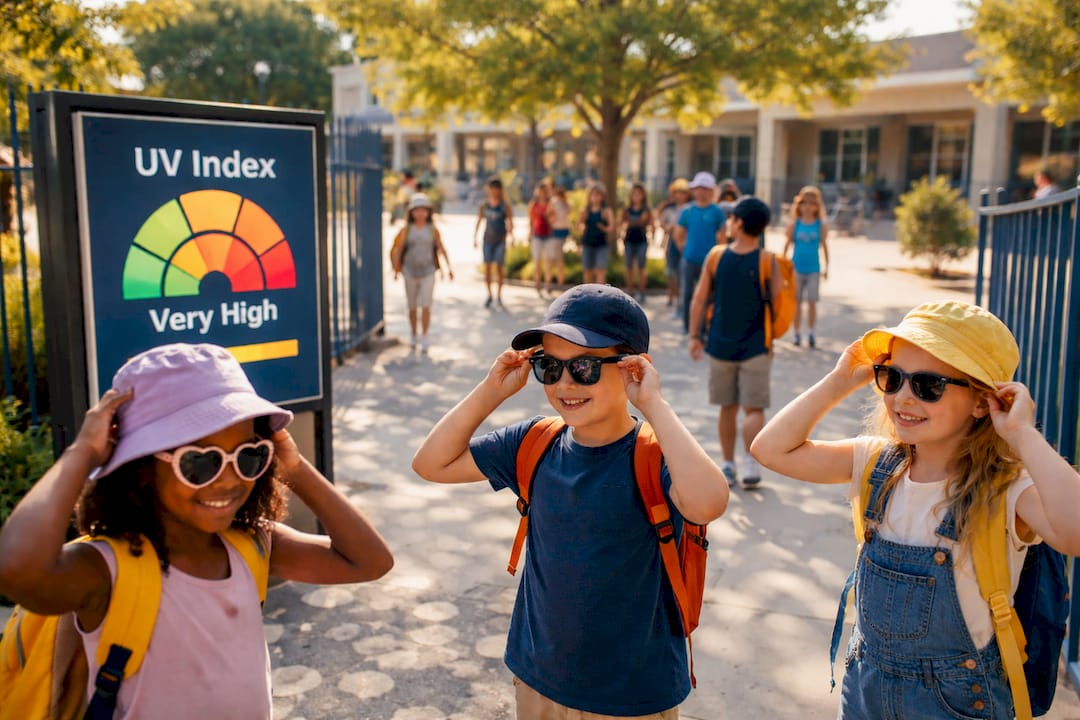
A whole-school approach produces better results than isolated rules. Embedding sun safety systematically across lessons, assemblies, and daily routines leads to more independent protective behavior from students. The policy stops being a rule and becomes a habit.
Practical integration strategies include:
- Weave sun safety into the curriculum. Science, health, and physical education classes all offer natural entry points. Students who understand why UV exposure is harmful follow rules more consistently.
- Use assemblies and morning routines. A brief reminder during morning assembly before outdoor activity days reinforces the habit without taking class time.
- Engage parents directly. Send home clear guidance on what sun protection gear students need to bring. Encouraging students to pack their own gear builds personal accountability and strengthens long-term habits.
- Have staff model the behavior. Teachers and aides who wear hats and apply sunscreen outdoors set a visible norm. Students notice when adults skip protection.
“Sun safety education works best when it is treated as a life skill, not a school rule. Students who learn to manage their own protection independently carry that behavior into adulthood.” — Melanoma Fund, Sunguarding Schools
Address misconceptions directly in classroom lessons. Up to 80% of UV rays penetrate clouds, meaning overcast days still require full protection. Many students and parents assume clouds eliminate UV risk. Correcting that belief is one of the highest-impact things a school can do.
3. Which sun protection apparel works best for school policies?
Clothing is the most reliable form of UV protection because it does not wash off, fade, or require reapplication. Schools that specify apparel in their uniform policies remove the inconsistency that sunscreen-only approaches create.
Hats
Sun-safe hats are non-negotiable. The three approved styles are:
- Legionnaire hats cover the neck and ears with a rear flap, making them the strongest option for younger students.
- Broad-brimmed hats (minimum 7.5 cm brim) protect the face, ears, and neck from all angles.
- Bucket hats offer full-circle coverage and are practical for active play.
Baseball caps protect only the face and forehead. They leave the ears, neck, and sides of the face exposed. Policies that permit baseball caps as an alternative are not meeting the standard.
UPF-rated clothing
UPF 50+ fabric blocks more than 98% of UV radiation. When selecting uniform items or recommending gear to parents, look for certified UPF ratings, not just dark colors or tight weaves. BANZ produces UPF 50+ children’s sun hats that meet school policy requirements and are designed for active wear.
Sunglasses
Schools should encourage close-fitting, wrap-around sunglasses that meet recognized safety standards. UV-related eye damage is cumulative. Sunglasses that cover the full eye area reduce that risk effectively. For younger students, a children’s sunglass case helps keep eyewear protected and ready to use.
Pro Tip: When updating uniform policies, specify the UPF rating and hat style by name. Vague language like “appropriate sun hat” gives parents and students too much room to interpret.
4. How should schools conduct shade audits and monitor UV risk?
Shade is dynamic. It shifts with the time of day, season, and sun angle. A playground that is well-shaded in the morning may be fully exposed by midday. Schools that assume shade coverage is fixed are working from inaccurate information.
A shade audit identifies where and when protection is adequate. Key steps:
- Walk the grounds at multiple times. Conduct audits in the morning, at midday, and in the afternoon during both summer and winter terms.
- Map sun-safe zones. Mark areas with reliable shade on a site plan. Use this map to assign outdoor activity locations by time of day.
- Assess existing structures. Check shade sails, trees, and covered walkways for gaps, wear, and coverage angles.
- Identify high-risk zones. Sports fields, open playgrounds, and uncovered eating areas typically require additional shade investment.
- Plan portable shade options. Pop-up canopies and shade tents extend coverage for events and sports days when permanent structures are insufficient.
| Shade audit element | Frequency | Purpose |
|---|---|---|
| Full grounds walk | Twice per year (summer and winter) | Identify seasonal coverage gaps |
| Midday exposure check | Monthly during high-UV months | Confirm peak-hour risk zones |
| Structure condition review | Annually | Assess wear, gaps, and replacement needs |
| Activity zone mapping | Each semester | Align outdoor scheduling with safe zones |
Technology supports ongoing monitoring. Real-time UV apps give staff the data to make same-day decisions. Pairing app data with a completed shade audit creates a practical, low-cost monitoring system that any school can maintain.
5. Addressing the primary-to-secondary school transition gap
Inconsistency between primary and secondary school policies leads directly to lapses in sun protection behavior among older students. This is one of the most under-addressed problems in school sun safety planning. Students who followed strict sun safety rules in primary school often abandon those habits when secondary schools reduce enforcement.
Secondary schools frequently deprioritize sun protection policies, treating them as relevant only for younger children. That assumption is wrong. UV exposure is cumulative across a lifetime, and the teenage years involve significant time outdoors for sports, events, and activities.
Secondary schools should maintain the same hat and sunscreen requirements as primary schools. Policies that frame sun safety as a life skill rather than a childhood rule hold up better across age groups. Peer-led education programs and student health committees can reinforce norms without making the policy feel imposed.
6. Why sunscreen-only policies consistently fall short
Policies that focus exclusively on sunscreen fail due to inconsistent student application and logistical challenges. Sunscreen requires correct application, adequate quantity, and timely reapplication. In a school setting, those conditions are rarely met consistently across an entire student population.
Structural and environmental controls remove the dependency on individual behavior. Shade provision, scheduling adjustments, and uniform requirements work whether or not a student remembered to apply sunscreen that morning. The most effective school sun safety plans combine behavioral and environmental measures. Neither approach alone is sufficient.
Many people underestimate how quickly UV exposure causes skin damage, which is why real-time UV guidance matters. A student who spends 20 minutes on an exposed playground at midday during a high-UV day accumulates meaningful damage. Schools that rely on sunscreen as the primary defense are leaving significant risk unaddressed.
Key takeaways
Effective school sun protection requires combining scheduling controls, protective apparel, sunscreen protocols, shade provision, and consistent education across all year levels.
| Point | Details |
|---|---|
| UV threshold triggers policy | Require sun protection whenever the UV index reaches 3 or above, not just on sunny days. |
| Hats must meet coverage standards | Mandate legionnaire, broad-brimmed, or bucket hats. Baseball caps do not protect ears and neck. |
| Sunscreen alone is not enough | Combine sunscreen with shade, scheduling, and clothing to cover gaps in individual application. |
| Shade audits must be seasonal | Conduct audits in summer and winter to account for sun angle and shifting coverage zones. |
| Secondary schools must maintain standards | Reducing enforcement as students age creates habit gaps that increase lifetime UV exposure. |
What schools get wrong about sun protection policies
I have reviewed a lot of school sun safety policies over the years, and the most common mistake is treating sunscreen as the policy. Schools write a rule that says “students must apply sunscreen before going outside” and consider the job done. That approach fails in practice every single time.
The students who most need protection are the ones least likely to apply sunscreen correctly on their own. Younger children apply too little. Older students skip it entirely. And no one is reapplying every two hours during a full school day. A sunscreen rule without structural backup is not a policy. It is a wish.
What actually works is building protection into the environment and the schedule so that individual compliance matters less. Move recess earlier. Add shade structures to exposed play areas. Specify hat styles in the uniform code. These measures work passively. They do not depend on a student remembering something before they walk out the door.
The secondary school transition gap is the other issue I see consistently overlooked. Primary schools often do this well. Secondary schools drop the ball. The reasoning seems to be that older students can manage their own protection. But the data shows the opposite: enforcement gaps at the secondary level undo years of habit-building. Keeping the same standards across all year levels is not overreach. It is continuity.
— Shari M. Murphy
Sun protection gear that supports your school policy
Schools set the standard. Parents and students need gear that meets it.
BANZ has been building UPF 50+ sun protection products for children since its founding in Australia, and its products are now used by families across six continents. For schools updating uniform requirements or communicating gear standards to parents, BANZ offers hats, sunglasses, and accessories designed specifically for active children. The Outdoor Hero bundle for ages 5–8 covers the core gear needs in one package. For schools looking at eye protection specifically, BANZ’s UV swim goggles and goggles and accessories range meet the wrap-around, UV-blocking standard that best-practice policies require.
FAQ
What is a school sun safety policy?
A school sun safety policy is a formal set of rules that reduces students’ UV exposure during outdoor activities. It covers scheduling, protective clothing, sunscreen use, shade provision, and student education.
When should sun protection rules apply at school?
Sun protection rules apply whenever the UV index reaches 3 or above. That level can occur year-round in many regions, not only during summer months.
What type of hat meets school sun safety standards?
Legionnaire hats, broad-brimmed hats with a minimum 7.5 cm brim, and bucket hats all meet the standard. Baseball caps do not provide adequate coverage for ears and neck.
Does sunscreen alone satisfy a school sun protection policy?
No. Sunscreen alone is insufficient because students apply it inconsistently and rarely reapply every 2 hours. Effective policies combine sunscreen with shade, scheduling, and protective clothing.
How often should schools review their sun protection policy?
Schools should review their policy at least annually and conduct shade audits twice per year, once in summer and once in winter, to account for seasonal changes in UV levels and sun angle.