

UVA and UVB rays are the two types of ultraviolet radiation that reach Earth’s surface and damage your skin in distinct ways. UVA rays make up roughly 95% of the UV radiation that hits your skin daily, while UVB accounts for the remaining 5%. Understanding the differences between UVA and UVB is not just academic. It directly shapes which sunscreen you buy, when you go outside, and how well you protect your kids year-round. This guide covers UVA vs UVB rays explained in plain terms, with the science and practical steps you need.
What are UVA rays and how do they affect your skin?
UVA rays sit in the 315–400 nm wavelength range and are the longer of the two UV types. That longer wavelength lets them penetrate all the way into the dermis, the middle layer of your skin, where collagen and elastin live.
The effects of UVA rays build up silently. You do not feel them the way you feel a sunburn. Over time, UVA penetrates the dermis causing premature aging, deep wrinkling, and a loss of skin elasticity. That leathery, aged look common in people with high lifetime sun exposure is largely a UVA story.
UVA also triggers reactive oxygen species inside skin cells. These molecules indirectly damage DNA, amplifying cancer risk on top of what UVB does directly. The Skin Cancer Foundation links UVA exposure to melanoma, the deadliest form of skin cancer.
Two facts about UVA make it especially tricky to avoid:
- UVA intensity stays relatively constant throughout the day, unlike UVB.
- UVA passes through clouds and through standard window glass, meaning you can accumulate damage while sitting in a car or working near a window.
Pro Tip: Check your car windows. Standard clear glass blocks most UVB but lets significant UVA through. If you drive regularly, apply broad-spectrum sunscreen to your arms and face before getting in the car.
What are UVB rays and how do they cause sunburn?
UVB rays occupy the 280–315 nm wavelength range and are shorter and more energetic than UVA. They hit the epidermis, the outermost skin layer, and cause the redness and pain you recognize as sunburn.
The damage UVB causes is direct and fast. UVB photons are absorbed by DNA, creating molecular lesions called cyclobutane pyrimidine dimers. These DNA mutations are the primary driver of squamous cell carcinoma and basal cell carcinoma, the two most common skin cancers.
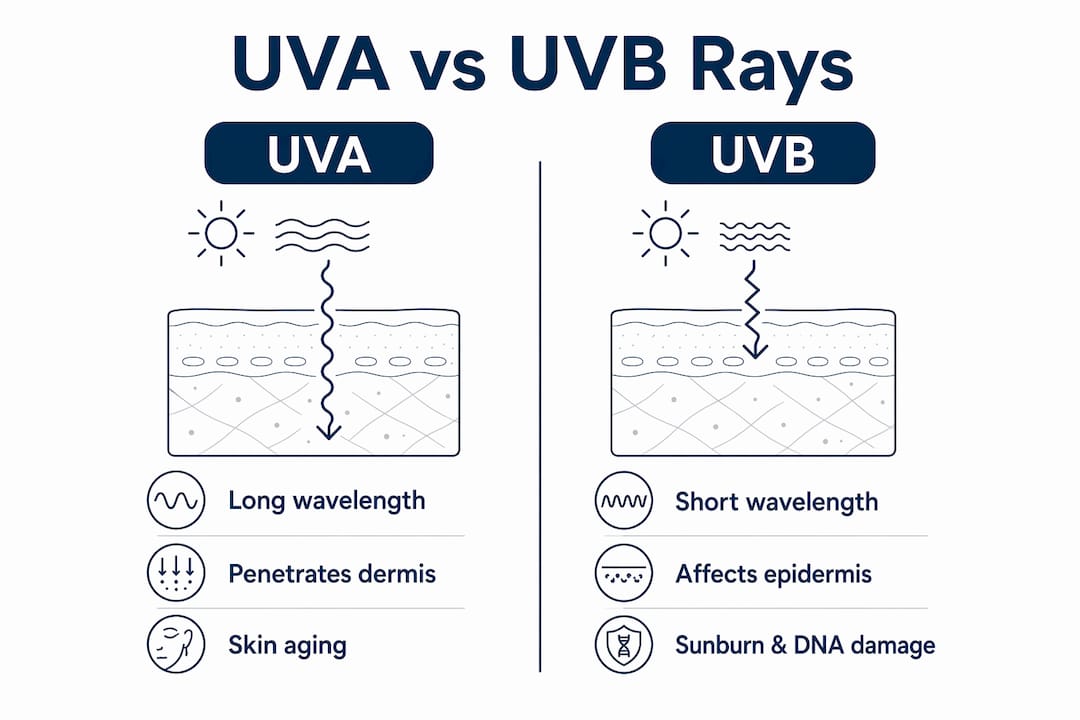
UVB intensity is not constant. It peaks sharply between 10 AM and 4 PM, with nearly 50% of daily UVB falling in that midday window. That concentration matters for planning outdoor time, especially for children.
Key UVB facts worth knowing:
- UVB is blocked more effectively by clouds and atmosphere than UVA, but not eliminated.
- High altitude and reflective surfaces like snow and water increase UVB intensity significantly, making ski trips and beach days equally high-risk.
- UVB also triggers vitamin D synthesis in the skin, which is the one biological benefit of UV exposure.
- SPF ratings on sunscreen labels measure protection against UVB only, not UVA.
The vitamin D angle leads some people to skip sunscreen occasionally. That trade-off is not worth it. Brief, incidental sun exposure throughout the week provides adequate vitamin D for most people without deliberate unprotected exposure.
UVA vs UVB: how do they compare?
The core differences between UVA and UVB come down to wavelength, penetration depth, and the type of damage they cause. The table below puts them side by side.
| Feature | UVA | UVB |
|---|---|---|
| Wavelength | 315–400 nm | 280–315 nm |
| Skin layer reached | Dermis (middle layer) | Epidermis (outer layer) |
| Primary effect | Aging, wrinkling, indirect DNA damage | Sunburn, direct DNA mutations |
| Cancer link | Melanoma | Squamous and basal cell carcinoma |
| Passes through glass | Yes | Mostly blocked |
| Intensity variation | Relatively constant all day | Peaks 10 AM to 4 PM |
| Proportion of UV at Earth’s surface | ~95% | ~5% |
| Blocked by SPF alone | No | Yes |
The most important takeaway from this comparison: SPF only measures UVB protection. A sunscreen labeled SPF 50 tells you nothing about its UVA coverage. Broad-spectrum sunscreens protect against both and are the only type worth buying. The Merck Manual recommends SPF 30 or higher with broad-spectrum labeling as the minimum standard.
Both rays contribute to skin cancer. UVB drives the mutations most linked to non-melanoma cancers. UVA drives the deeper damage linked to melanoma. Protecting against one and ignoring the other leaves a real gap in your defense.
Pro Tip: Look for the words “broad spectrum” on the sunscreen label, not just a high SPF number. SPF 100 without broad-spectrum coverage still leaves your skin exposed to UVA damage.
How to protect yourself from both UVA and UVB year-round
Effective sun protection addresses both ray types at once. Here is a practical, ranked approach.
- Use broad-spectrum sunscreen with SPF 30 or higher. Apply it 15 minutes before going outside. Reapply every two hours, or immediately after swimming or sweating. SPF ratings measure UVB protection only, so the broad-spectrum label is non-negotiable.
- Time outdoor activities around UVB peaks. Schedule walks, sports, and outdoor play before 10 AM or after 4 PM to reduce peak UVB exposure. UVA remains present throughout the day, so sunscreen is still required.
- Cover up with clothing. Tightly woven, dark-colored fabrics block more UV than light, loose weaves. UPF-rated clothing, like the UPF 50+ gear BANZ produces, provides a measurable and consistent barrier. Learn more about clothing and UV blocking to choose the right fabrics for your kids.
- Protect your eyes with UV-blocking sunglasses. UV radiation damages the cornea and lens over time. Look for lenses labeled UV400, which block all light up to 400 nm, covering both UVA and UVB.
- Check the UV Index before heading out. The UV Index communicates the strength of UV radiation on a scale from 1 to 11+. A reading of 3 or above warrants sunscreen and protective clothing. The BANZ Protect app provides real-time UV monitoring, which removes the guesswork for parents managing kids outdoors.
Additional protection habits that matter:
- Apply sunscreen on overcast days. Clouds reduce but do not eliminate UV radiation.
- Protect skin near windows at home and in the car, where UVA penetrates freely.
- For children, activity-rated UV protection gear is worth the investment, since kids accumulate significant lifetime UV exposure during outdoor play.
Common myths about UV rays and sun protection
Several widely held beliefs about UV exposure are simply wrong. Correcting them changes how you protect yourself and your family.
- “It’s not sunny, so UV isn’t a problem.” Temperature and cloud cover do not determine UV risk. UV radiation is present even on cool, overcast days. A cloudy winter day can still deliver meaningful UVA exposure.
- “A base tan protects you.” A tan is a skin injury response signaling DNA damage. It offers minimal SPF-equivalent protection and increases your cumulative cancer risk. No safe base tan exists.
- “I’m safe indoors.” Standard glass blocks most UVB but allows significant UVA to pass through. Sitting near a window for hours each day adds up. Modern laminated glass blocks more UVA than standard clear glass, but most homes and older vehicles use standard glass.
- “Tanning beds are safer than the sun.” UV radiation from tanning beds is classified as a carcinogen. Tanning beds emit mostly UVA radiation and some UVB, directly increasing melanoma risk.
- “High SPF means full protection.” SPF measures UVB protection only. An SPF 70 sunscreen without broad-spectrum coverage provides no meaningful UVA defense.
Key Takeaways
Broad-spectrum sunscreen with SPF 30 or higher, combined with UPF-rated clothing and UV-aware scheduling, is the only complete defense against both UVA and UVB damage year-round.
| Point | Details |
|---|---|
| UVA penetrates deeper | UVA reaches the dermis, causing aging and contributing to melanoma risk. |
| UVB causes direct DNA damage | UVB triggers mutations in the epidermis, driving sunburn and non-melanoma skin cancers. |
| SPF measures UVB only | Always choose broad-spectrum sunscreen to cover both UVA and UVB exposure. |
| UV is present year-round | Clouds, cool temperatures, and windows do not stop UVA from reaching your skin. |
| No tan is safe | A tan signals DNA damage and raises long-term skin cancer risk regardless of how it was acquired. |
What years of watching families in the sun taught me
Most parents I talk to focus entirely on sunburn as the signal that something went wrong. If the kids come home red, they feel like they failed. If the kids come home looking fine, they feel like they succeeded. That framing misses the bigger threat entirely.
UVA damage is invisible in the moment. It accumulates over decades. The melanoma diagnosed at 45 often traces back to years of unprotected UVA exposure that never produced a single sunburn. Children are especially vulnerable because they have more years ahead for that damage to compound.
The other thing I see consistently: parents apply sunscreen once at the start of the day and consider the job done. Reapplication every two hours is not optional. Sweat, water, and friction all degrade sunscreen coverage faster than most people expect.
My honest recommendation is to treat sun protection the same way you treat car seat safety. You do not skip it because the drive is short or the weather looks fine. You build it into the routine and use gear rated for the job. Broad-spectrum SPF 30+, UPF-rated clothing, and a UV Index check before outdoor time. That combination covers both UVA and UVB without requiring perfect conditions.
— Shari M. Murphy
Sun protection gear for kids that covers UVA and UVB
Knowing the science is step one. Having the right gear makes it practical every day.
BANZ builds sun protection products specifically for children, starting from the Australian standard of UPF 50+. Their UV swim goggles for kids block both UVA and UVB at the waterline, where reflected UV exposure is highest. The BANZ Protect app adds real-time UV monitoring so parents can make informed decisions about outdoor time without guessing. For families who want a complete outdoor safety kit, the Outdoor Hero bundle for ages 5–8 covers the key protection categories in one purchase. BANZ has served over 2 million families across six continents, and their product range reflects that depth of experience in real outdoor conditions.
FAQ
What is the main difference between UVA and UVB rays?
UVA rays (315–400 nm) penetrate deeper into the skin and cause aging and melanoma risk, while UVB rays (280–315 nm) damage the outer skin layer and cause sunburn and direct DNA mutations.
Does SPF protect against both UVA and UVB?
SPF ratings only measure UVB protection. You need a sunscreen labeled “broad spectrum” to get coverage against both UVA and UVB rays.
Can you get UV damage through a window?
Yes. Standard glass blocks most UVB but allows significant UVA to pass through, meaning skin damage can occur indoors or while driving.
Are UVA rays present on cloudy days?
UVA radiation is present year-round regardless of cloud cover or temperature. Clouds reduce but do not eliminate UV exposure, making daily sunscreen use necessary.
Is a tan a sign of healthy skin?
No. A tan is a skin injury response indicating DNA damage has occurred. The Skin Cancer Foundation confirms no safe base tan exists, and tanning increases long-term skin cancer risk.