

Las capas de protección solar para niños pequeños son una combinación de ropa con FPU, sombreros de ala ancha, gafas de sol con protección UV, protector solar mineral y sombra que trabajan en conjunto para prevenir la exposición dañina a los rayos UV durante las actividades al aire libre. El enfoque SunSmart del Cancer Council define cinco capas distintas de protección, cada una compensando las posibles deficiencias de las otras. Ninguna capa es suficiente por sí sola. La piel de los niños pequeños es más delgada y sensible que la piel de los adultos, lo que significa que el riesgo de no hacerlo bien es mayor. Esta guía le ofrece capas de protección solar específicas y prácticas para niños pequeños con ejemplos que puede usar hoy mismo.
1. ¿Cuáles son las capas esenciales de protección solar para niños pequeños?
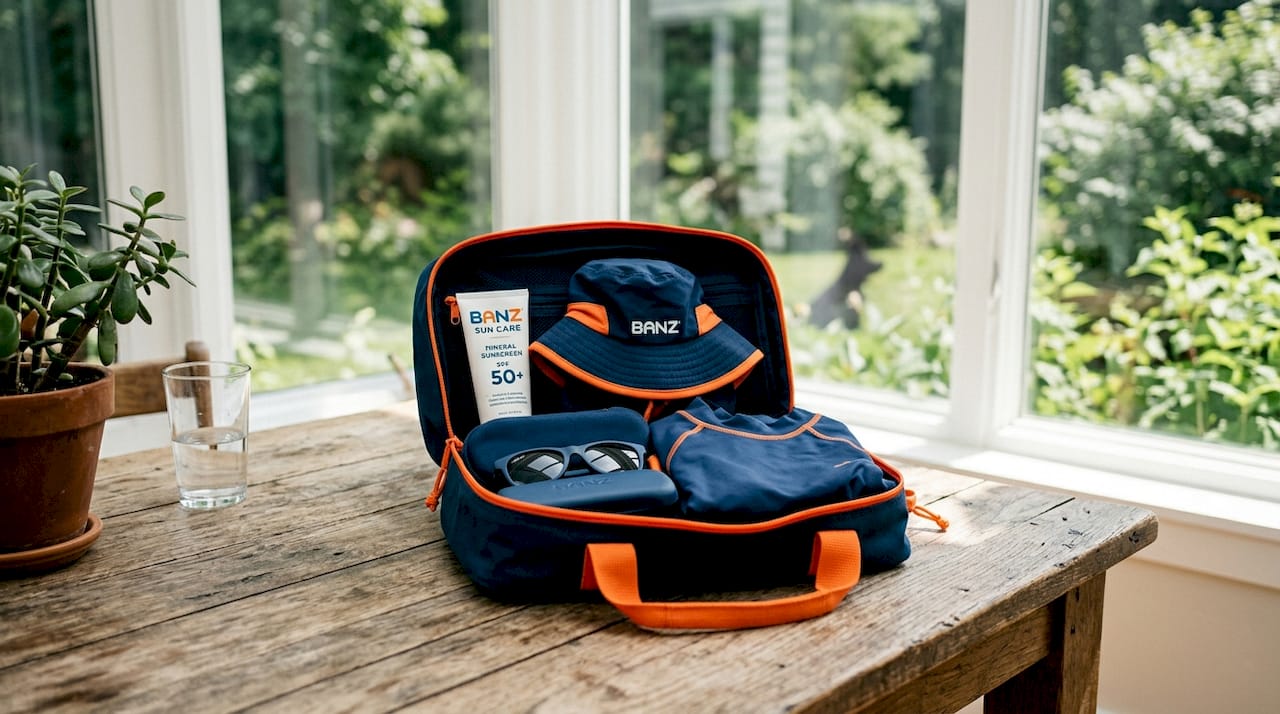
Las cinco capas que recomienda el Cancer Council son la ropa, los sombreros, el protector solar, la sombra y las gafas de sol. Cada una bloquea o desvía la radiación UV de manera diferente, y juntas crean redundancia. Si el protector solar se desprende durante el juego, el sombrero y la camisa siguen funcionando. Esa superposición es el objetivo principal.
Así es como se ve cada capa en la práctica:
- Ropa con FPU: Camisetas de manga larga, pantalones de natación de cuerpo entero y camisas ligeras de algodón o poliéster con FPU 50+. El traje de baño UV para niños pequeños de BANZ es una opción de una pieza que cubre el torso, los hombros y la parte superior de las piernas en una sola prenda.
- Sombreros para el sol: Sombreros de ala ancha, sombreros de pescador y sombreros de legionario que cubren la cara, las orejas y la nuca. Los sombreros de ala ancha y los de legionario reducen la exposición a los rayos UV en los ojos hasta un 50% en comparación con las gorras de béisbol. Este número es importante porque el daño ocular causado por los rayos UV es acumulativo y comienza en la infancia.
- Protector solar: Los protectores solares a base de minerales con óxido de zinc o dióxido de titanio son la opción preferida para los niños pequeños. Estos ingredientes se quedan en la superficie de la piel en lugar de absorberse, lo que los hace más suaves para las pieles sensibles y menos propensos a causar irritación.
- Sombra: Tiendas de playa plegables, capotas para cochecitos y sombrillas de patio. La sombra es la capa más pasiva y la más fácil de olvidar usar de forma constante. Consulte la guía de BANZ sobre soluciones de sombra para niños pequeños para opciones de productos específicos.
- Gafas de sol: Gafas de sol con clasificación UV400 que se ajusten a la cara de los niños pequeños. Las gafas de sol para adultos no bloquean la exposición periférica a los rayos UV de la misma manera que lo hace un par de gafas de sol para niños pequeños correctamente ajustadas.
Consejo profesional: Prepare un kit solar dedicado con las cinco capas ya empacadas. Cuando tome la bolsa, todas las capas vendrán con ella. Esto elimina la lista de verificación mental y reduce la posibilidad de olvidar una capa.
2. Cómo aplicar correctamente las capas de protección solar en niños pequeños
La secuencia y el tiempo importan tanto como los productos en sí. Primero aplique las barreras físicas, luego el protector solar en la piel expuesta. Este es el orden que funciona:
- Vista a su hijo con ropa con clasificación FPU antes de salir al exterior.
- Póngale el sombrero para el sol. Asegúrelo con una correa para la barbilla o un cordón si su hijo tiende a quitárselo.
- Aplique protector solar en toda la piel expuesta, incluyendo el dorso de las manos, las orejas y la nuca si el sombrero no la cubre por completo.
- Póngale las gafas de sol al final, ya que los niños pequeños a menudo se resisten a ellas y ponérselas justo antes de salir reduce el tiempo que pueden quitárselas.
- Muévase a la sombra o instale una estructura de sombra en su destino antes de que el niño pequeño empiece a jugar.
El protector solar aplicado de 15 a 30 minutos antes de salir al aire libre le da tiempo para adherirse a la piel. Vuelva a aplicarlo cada 90 a 120 minutos durante una exposición prolongada e inmediatamente después de nadar o sudar mucho. Ese tiempo se acorta más rápido de lo que la mayoría de los padres esperan durante el juego activo al aire libre.
Consejo profesional: Vincule la reaplicación del protector solar a una señal rutinaria, como una pausa para un refrigerio o una parada para beber agua. La reaplicación basada en la rutina reduce los puntos olvidados y mantiene el sistema de capas completo funcionando durante toda la salida.
El Royal Children’s Hospital señala que los niños pueden quemarse en tan solo 10 minutos cuando el índice UV alcanza 3 o más. Ese umbral es más bajo de lo que la mayoría de la gente supone y a menudo se alcanza en días nublados, no solo bajo el sol directo del verano.
3. Comparación de opciones populares de ropa y sombreros con protección solar
No toda la ropa con FPU rinde por igual. El tipo de tejido, la densidad del tejido y el ajuste afectan la cantidad de radiación UV que realmente llega a la piel.
| Característica | Sintético (poliéster, nailon) | Fibra natural (algodón, lino) |
|---|---|---|
| Bloqueo UV | Más alto, debido al tejido apretado | Variable, depende del tejido |
| Durabilidad | Alta, resiste el estiramiento | Moderada |
| Gestión de la humedad | Absorbe el sudor rápidamente | Absorbe la humedad |
| Comodidad con el calor | Puede sentirse cálido | Transpirable |
| Mejor caso de uso | Juegos acuáticos, uso activo al aire libre | Uso informal al aire libre |
Los tejidos sintéticos como el poliéster y el nailon suelen ofrecer una mejor protección UV que las fibras naturales con tejidos sueltos. Esto no significa que el algodón sea inútil. Una camisa de algodón de tejido apretado con clasificación FPU 50+ funciona bien. La etiqueta de clasificación es el indicador fiable, no el tipo de fibra por sí solo.
Para los sombreros, el estilo determina la cobertura:
- Los sombreros de pescador cubren la cara y las orejas, pero dejan la nuca parcialmente expuesta.
- Los sombreros de ala ancha (ala de al menos 7.5 cm) cubren la cara, las orejas y el cuello. El sombrero para el sol con cordón para niños de BANZ utiliza un cordón ajustable para la barbilla para mantener el sombrero en su lugar en niños pequeños activos.
- Los sombreros legionarios proporcionan la cobertura más completa, con una solapa completa que cubre el cuello y las orejas. Son la mejor opción para sesiones prolongadas al aire libre.
- Los sombreros reversibles añaden un beneficio práctico. El sombrero para el sol reversible con FPU 50+ de BANZ le ofrece dos looks en un solo sombrero, lo que ayuda con los niños pequeños que se resisten a usar el mismo sombrero repetidamente.
Las gorras de béisbol y las viseras no califican como sombreros seguros para el sol para niños pequeños. Dejan las orejas y el cuello completamente expuestos, que son dos de las áreas más comúnmente quemadas en niños pequeños.
4. Ejemplos de protección solar según la situación, el clima, la actividad y la edad
La aplicación de capas de protección solar no es una fórmula fija. Cambia según el índice UV, lo que esté haciendo su hijo y su edad.
Días más frescos o con índice UV inferior a 3: Una camisa ligera de manga larga y un sombrero de cubo pueden ser suficientes. El protector solar sigue siendo recomendable en zonas expuestas como la cara y las manos, pero la urgencia de aplicar todas las capas es menor. El riesgo de UV no siempre se correlaciona con la temperatura, así que consulte el índice UV en lugar de confiar en lo cálido que se sienta.
Días con índice UV alto (3 o superior): Utilice las cinco capas sin excepción. Añada un sombrero de legionario, aplique protector solar en todas las zonas expuestas y coloque una tienda de sombra o una sombrilla en su ubicación al aire libre. Limite el tiempo de exposición directa al sol entre las 10 a.m. y las 4 p.m.
Actividades acuáticas: El agua refleja la radiación UV y elimina el protector solar rápidamente. Use un traje de baño de una pieza con clasificación FPU que cubra el torso y los hombros. Aplique protector solar mineral resistente al agua antes de entrar al agua y vuelva a aplicarlo inmediatamente después de secarse. Un sombrero de ala ancha usado antes y después de nadar añade cobertura durante los períodos de transición.
Bebés menores de 6 meses: La Academia Estadounidense de Pediatría aconseja evitar por completo la luz solar directa para este grupo de edad. La sombra y la ropa protectora son las herramientas principales. El protector solar solo debe aplicarse en pequeñas áreas expuestas cuando no haya sombra disponible. Esta es la única situación en la que las capas de ropa y sombra tienen plena prioridad sobre el protector solar.
Niños pequeños de 1 a 3 años: Este grupo de edad es el más activo y el más difícil de mantener cubierto. Los niños pequeños a menudo se quitan las capas debido al movimiento, se quitan los sombreros y se frotan el protector solar. Revise y ajuste todas las capas cada 30 a 45 minutos durante el juego activo al aire libre.
Un punto que vale la pena mencionar directamente: la melanina proporciona protección parcial contra los rayos UV, pero no elimina la necesidad de capas físicas y protector solar en niños de cualquier tono de piel. Todos los niños pequeños necesitan el conjunto completo de capas, independientemente de su complexión.
Puntos clave
La protección solar eficaz para niños pequeños requiere que las cinco capas trabajen juntas: ropa con FPU, un sombrero seguro para el sol, protector solar mineral, sombra y gafas de sol con protección UV.
| Punto | Detalles |
|---|---|
| Utilice las cinco capas | La ropa, los sombreros, el protector solar, la sombra y las gafas de sol cubren las deficiencias que dejan los demás. |
| Aplique el protector solar correctamente | Aplique de 15 a 30 minutos antes de salir y vuelva a aplicar cada 90 a 120 minutos. |
| Adapte las capas al índice UV | Consulte el índice UV diariamente y aplique protección completa siempre que alcance 3 o más. |
| Elija sombreros según la cobertura | Los sombreros de ala ancha y los sombreros legionarios superan a los sombreros de cubo y las gorras de béisbol para niños pequeños. |
| Adapte por edad y actividad | Los bebés menores de 6 meses dependen de la sombra y la ropa. Los niños pequeños activos necesitan controles frecuentes de las capas. |
Lo que he aprendido al ver a los padres equivocarse
Por Shari M. Murphy
El error más común que veo es tratar el protector solar como la única capa importante. Los padres lo aplican con cuidado, luego se saltan el sombrero porque el niño está molesto, o se saltan la sombra porque montar una tienda parece demasiado esfuerzo. El resultado es un niño que está técnicamente "protegido con protector solar" pero que sigue quemándose las orejas y el cuello.
El segundo error es la inconsistencia. La protección solar aplicada a las 9 a.m. y olvidada a las 11 a.m. no es una estrategia de protección. Es una falsa sensación de seguridad. El sistema de capas solo funciona cuando los cinco componentes se mantienen durante toda la salida, no solo al principio.
Lo que realmente funciona es incorporar las capas a la rutina física en lugar de a la mental. Mantenga el kit solar junto a la puerta. Guarde el sombrero con los zapatos. Ponga un recordatorio en el teléfono para la reaplicación del protector solar. No son pasos complicados. Son anclajes de hábitos que eliminan la toma de decisiones en el momento en que un niño pequeño ya está corriendo hacia el patio de juegos.
Una cosa más: no espere a un día caluroso para empezar. El índice UV alcanza 3 en las mañanas templadas de primavera y en las tardes nubladas de otoño. El hábito de aplicar capas debe ser independiente del clima, no reservado para los días de playa.
— Shari M. Murphy
Cree el kit de protección solar de su hijo con BANZ
BANZ diseña equipo de protección solar específicamente para niños pequeños y niños, con clasificaciones FPU 50+ en sombreros, trajes de baño y accesorios. Cada producto está diseñado para permanecer en niños activos y resistir el uso repetido al aire libre.
El sombrero de sol de bolsillo FPU 50+ de BANZ es un punto de partida práctico. Cuenta con un ala ancha, ajuste regulable y un bolsillo integrado para facilitar el almacenamiento. Combínelo con un sombrero de sol reversible para bebés para hermanos menores y un traje de baño con clasificación FPU para cubrir la capa de actividad acuática. Explore la gama completa de equipo de seguridad solar para niños para ver cómo cada producto encaja en una configuración completa de capas.
Preguntas frecuentes
¿Cuáles son las cinco capas de protección solar para niños pequeños?
Las cinco capas son ropa con FPU, un sombrero seguro para el sol, protector solar mineral, sombra y gafas de sol con protección UV. El programa SunSmart del Cancer Council recomienda usar las cinco juntas para que las deficiencias de una capa sean cubiertas por las otras.
¿Qué tipo de protector solar es mejor para los niños pequeños?
Los protectores solares a base de minerales que contienen óxido de zinc o dióxido de titanio son la mejor opción para los niños pequeños. Estas fórmulas se quedan en la superficie de la piel, proporcionan protección UV de amplio espectro y son menos propensas a irritar la piel sensible que las alternativas químicas.
¿Con qué frecuencia debe volver a aplicar protector solar a un niño pequeño?
Vuelva a aplicar el protector solar cada 90 a 120 minutos durante la actividad al aire libre e inmediatamente después de nadar o sudar. Aplique la primera capa de 15 a 30 minutos antes de salir para que se adhiera a la piel.
¿Qué estilo de sombrero ofrece la mayor protección solar a los niños pequeños?
Los sombreros de legionario proporcionan la cobertura más completa, protegiendo la cara, las orejas y toda la nuca. Los sombreros de ala ancha con un ala mínima de 7.5 cm son la siguiente mejor opción. Las gorras de béisbol y las viseras no cumplen con los estándares de seguridad solar para niños pequeños.
¿Necesitan protector solar los bebés menores de 6 meses?
La Academia Estadounidense de Pediatría aconseja mantener a los bebés menores de 6 meses completamente fuera de la luz solar directa y confiar en la sombra y la ropa protectora como capas principales. El protector solar solo debe aplicarse en pequeñas áreas expuestas cuando no haya sombra disponible.
Recomendado
- Ejemplos de equipo de seguridad solar al aire libre para niños en 2026 – BANZ® Carewear USA
- Las mejores soluciones de sombra para niños pequeños al aire libre en 2026 – BANZ® Carewear USA
- Sombreros de sol reversibles para niños pequeños con protección FPU 50+ (en liquidación) – BANZ® Carewear USA
- Los mejores sombreros de sol para bebés 2026: Las mejores opciones – BANZ® Carewear USA